Reliable Product Sourcing Services for Shopify Stores
Reliable product sourcing services for Shopify stores help merchants compare sourcing platforms, verify suppliers and evaluate fit before committing to a workflow.
Hylke Reitsma is co-founder of Forthsuite and a supply chain specialist with 8+ years of hands-on experience at Shell, Verisure, and Stryker. He holds an MSc in Supply Chain Management from the University of Groningen and writes practical guides to help e-commerce teams run leaner, faster supply chains. Selected by Replit as 1 of 20 founders for the inaugural Race to Revenue Cohort #1 (2026) and certified as a Replit Platform Builder.
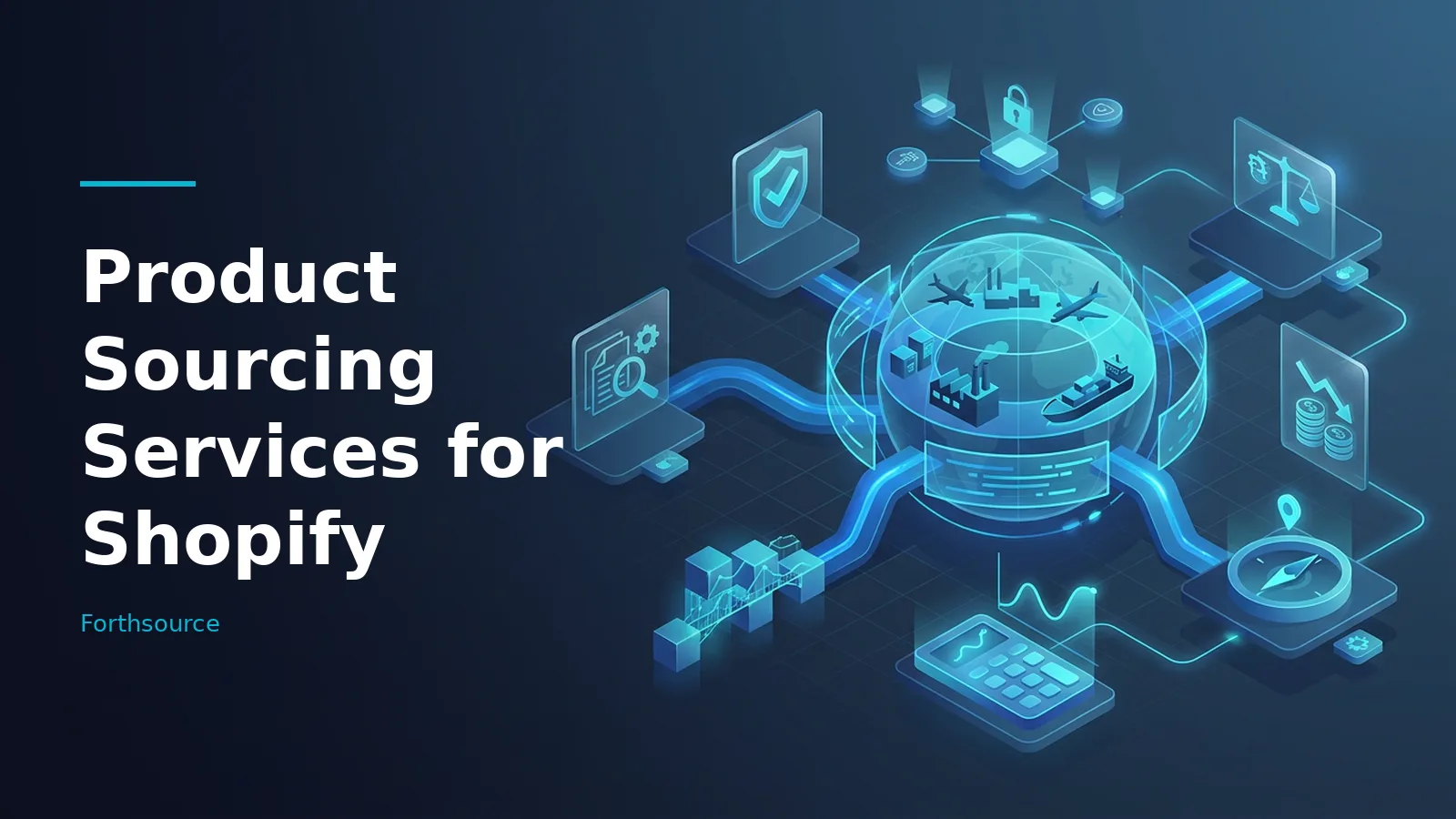
TL;DR: Reliable product sourcing services for Shopify stores help merchants compare platforms, verify suppliers and choose a sourcing workflow that fits their products and operations.
Last updated: July 2026
Why Product Sourcing Services Matter for E-commerce
Product sourcing remains one of the most critical—and challenging—aspects of running a successful Shopify store. Whether you're launching your first product line or scaling an established brand, finding reliable suppliers who can deliver quality products at competitive prices determines your profit margins, customer satisfaction, and long-term viability.
The e-commerce landscape has evolved dramatically. Today's Shopify merchants face unprecedented competition, rapidly shifting consumer expectations, and supply chain complexities that didn't exist even five years ago. Traditional methods of finding suppliers—cold-calling manufacturers, attending trade shows, or relying on word-of-mouth referrals—are no longer sufficient for merchants who need to move quickly and scale efficiently.
This is where product sourcing services become invaluable. These platforms and services act as intermediaries between e-commerce businesses and manufacturers, wholesalers, and distributors worldwide. They streamline the discovery process, provide verification mechanisms, and often handle negotiations, quality control, and logistics coordination.
The benefits extend beyond simple convenience. Product sourcing services help merchants:
- Access pre-vetted supplier networks that would take months or years to build independently
- Reduce the risk of fraud, quality issues, and communication breakdowns
- Negotiate better terms through collective bargaining power or platform relationships
- Compare multiple suppliers side-by-side with transparent pricing and minimum order quantities
- Streamline communication across language barriers and time zones
- Accelerate time-to-market for new product launches
For Shopify merchants specifically, sourcing services that integrate directly with your store ecosystem offer additional advantages. Instead of managing supplier relationships through scattered spreadsheets and email threads, modern platforms centralize everything within your existing workflow, syncing product data, inventory levels, and order information automatically.
The stakes are high. A single poor sourcing decision—choosing an unreliable supplier, misjudging quality standards, or committing to unfavorable payment terms—can devastate cash flow, damage your brand reputation, and erode customer trust. Conversely, establishing strong supplier partnerships through the right sourcing platform creates a competitive moat that's difficult for competitors to replicate.
What Is a Digital Sourcing Platform?
A digital sourcing platform is a technology-enabled marketplace or service that connects buyers with suppliers through an online interface. Unlike traditional sourcing methods that rely heavily on personal relationships and manual processes, digital platforms leverage software, databases, and automation to make supplier discovery, vetting, and management more efficient and transparent.
Think of a digital sourcing platform as the evolution of the traditional trade directory or sourcing agent. Where you once needed to physically visit trade shows in Guangzhou or hire expensive intermediaries to navigate foreign manufacturing hubs, modern platforms bring global supplier networks to your laptop screen.
The core components of a product sourcing platform typically include:
- Supplier Directory: A searchable database of manufacturers, wholesalers, and distributors, often categorized by product type, location, certifications, and specialization
- Verification Systems: Mechanisms to validate supplier credentials, business licenses, production capabilities, and track records
- Communication Tools: Built-in messaging, request-for-quotation (RFQ) systems, and sometimes real-time chat with translation capabilities
- Comparison Features: Side-by-side supplier comparisons showing pricing, minimum order quantities (MOQs), lead times, and terms
- Documentation Management: Storage and organization of contracts, product specifications, compliance certificates, and quality reports
- Integration Capabilities: APIs or native connections with e-commerce platforms like Shopify, ERP systems, and logistics providers
Digital sourcing platforms fall into several categories. Marketplace platforms like Alibaba operate as massive directories where thousands of suppliers list their capabilities and products. Curated platforms like Faire or Forthsource take a more selective approach, vetting suppliers before allowing them onto the platform and often providing additional services like payment protection or quality guarantees.
Some platforms specialize in specific geographies (sourcing from China, India, or Europe), product categories (fashion, electronics, food and beverage), or business models (dropshipping, private label, wholesale). Others offer end-to-end services that extend beyond supplier discovery to include product development, quality inspection, freight forwarding, and customs clearance.
The technological sophistication varies widely. Basic platforms function essentially as online directories with search and filtering capabilities. Advanced platforms incorporate artificial intelligence for supplier matching, blockchain for supply chain transparency, automated compliance checking, and predictive analytics to forecast supplier reliability and pricing trends.
For Shopify merchants, the most valuable digital sourcing platforms integrate directly with your store. This means product information, pricing updates, inventory availability, and order details flow seamlessly between your sourcing platform and Shopify admin, eliminating manual data entry and reducing errors.
How to Choose a Product Sourcing Platform
Selecting the right product sourcing platform requires evaluating multiple factors that directly impact your operational efficiency, risk exposure, and profitability. Not all sourcing services are created equal, and the wrong choice can lock you into unfavorable relationships or expose you to significant risks.
Supplier Vetting and Verification
The most critical criterion is how thoroughly the platform vets its supplier network. Ask specific questions about their verification process:
- Does the platform verify business registration and licenses?
- Are factory visits or third-party audits conducted?
- How does the platform verify production capacity claims?
- Are there background checks on company ownership and management?
- What quality certifications or compliance standards are required?
- How frequently is supplier information updated and re-verified?
Platforms like Forthsource offer free supplier verification services that go beyond basic credential checking. Look for platforms that provide detailed supplier profiles including production capabilities, previous client references, export history, and any red flags identified during due diligence.
The verification process should be transparent. You should understand exactly what checks have been performed and what hasn't been verified. Be wary of platforms that make blanket assurances about supplier quality without explaining their methodology.
Minimum Order Quantity (MOQ) Flexibility
MOQ requirements can make or break a product launch, especially for new merchants testing market demand. The best sourcing platforms either specialize in suppliers with low MOQs or provide tools to compare MOQ requirements across multiple suppliers easily.
Consider whether the platform:
- Clearly displays MOQs for each supplier and product category
- Offers filtering by MOQ ranges to match your budget and storage capacity
- Connects you with suppliers willing to negotiate on order quantities
- Provides consolidated shipping options to meet MOQs across product lines
- Explains how MOQs affect pricing to help you evaluate true costs
Some platforms facilitate group buying or pre-orders to help smaller merchants meet MOQ thresholds. Others focus exclusively on dropshipping arrangements where MOQs aren't relevant because you're ordering individual units as customer orders arrive.
Payment Terms and Protection
Payment mechanisms reveal a platform's maturity and trustworthiness. Examine the payment infrastructure carefully:
- Does the platform offer escrow services or payment protection?
- What payment methods are supported (wire transfer, PayPal, credit cards, trade financing)?
- Are there deposit requirements, and what protections exist if suppliers fail to deliver?
- Can you negotiate payment terms (net 30, 50% deposit/50% on delivery, etc.)?
- What dispute resolution mechanisms exist for payment disagreements?
- Are there transaction fees, and how do they compare to direct supplier payments?
Sophisticated platforms provide milestone-based payment releases, where funds transfer to suppliers only after meeting specific criteria like production completion, quality inspection passage, or successful delivery. This significantly reduces your risk compared to full upfront payments.
Communication Infrastructure
Effective communication prevents costly misunderstandings about product specifications, quality standards, delivery timelines, and problem resolution. Evaluate the platform's communication tools:
- Is there built-in messaging with conversation history saved permanently?
- Does the platform offer translation services for non-English suppliers?
- Can you upload and share technical specifications, design files, and sample images?
- Are there standardized RFQ templates to ensure consistent information gathering?
- How quickly do suppliers typically respond, and are response times tracked?
- Is there customer support to mediate communication challenges?
Platforms that centralize communication create accountability. When everything is documented within the platform rather than scattered across email, WhatsApp, and phone calls, you have clear records if disputes arise or you need to reference previous agreements.
Integration and Workflow Efficiency
For Shopify merchants, integration capabilities determine whether a sourcing platform enhances or disrupts your operations. The platform should connect seamlessly with your existing tools:
- Does it offer a native Shopify app or API integration?
- Can product catalogs sync automatically to your store?
- Do inventory levels update in real-time across systems?
- Can you push orders directly to suppliers without manual entry?
- Does it integrate with demand forecasting tools to optimize reorder timing?
- Are shipping and tracking updates automatically reflected in your Shopify admin?
Forthsource exemplifies this integration-first approach, allowing merchants to manage sourcing activities without leaving their Shopify environment.
Top Product Sourcing Services for Shopify Merchants
The product sourcing landscape includes diverse platforms serving different merchant needs, business models, and product categories. Understanding the major categories helps you select services aligned with your specific requirements.
Global Marketplace Platforms
Alibaba and AliExpress represent the largest and most established marketplace platforms, connecting merchants with primarily Chinese manufacturers and wholesalers. Alibaba focuses on bulk wholesale and custom manufacturing, while AliExpress caters more to smaller orders and dropshipping.
These platforms offer unmatched supplier variety and competitive pricing but require significant due diligence. Supplier quality varies enormously, verification standards are inconsistent, and merchants must navigate communication challenges, complex logistics, and quality control independently. They work best for experienced merchants comfortable managing risk and conducting their own supplier vetting.
Global Sources operates similarly but emphasizes verified suppliers and trade show connections, positioning itself as a more curated alternative to Alibaba with higher supplier quality standards and more robust verification processes.
Curated Wholesale Platforms
Faire has emerged as a leading platform for discovering unique brands and independent manufacturers, particularly in home goods, gifts, fashion accessories, and specialty products. The platform emphasizes small-batch production, artisanal products, and established brands rather than generic manufacturing.
Faire's strength lies in product curation, generous payment terms, and free returns on initial purchases. The platform works exceptionally well for boutique Shopify stores seeking differentiated products, though pricing is generally higher than direct-from-manufacturer sourcing.
Handshake (formerly acquired by Shopify) connects retailers with wholesale brands, emphasizing established consumer product companies and CPG brands. It's ideal for merchants wanting to carry recognized brands alongside their private label offerings.
Specialized Product Sourcing Platforms
Forthsource distinguishes itself through free supplier verification, transparent supplier profiles highlighting potential red flags, and MOQ comparison tools designed specifically for Shopify merchants. The platform focuses on reducing sourcing risk through comprehensive supplier due diligence while maintaining accessibility for merchants at all experience levels.
Forthsource's supplier verification process examines business registration, production capacity, export history, certifications, and financial stability. The platform surfaces potential concerns—unusual payment term requests, inconsistent communication, capacity mismatches—helping merchants identify problems before committing to orders.
Forthsource provides seamless integration, allowing merchants to manage supplier relationships, compare quotations, and track orders directly within their Shopify admin. This integration proves especially valuable when coordinating sourcing decisions with demand forecasting and inventory planning.
Dropshipping Platforms
Spocket, Modalyst, and SaleHoo specialize in dropshipping arrangements where suppliers ship directly to end customers, eliminating inventory holding requirements. These platforms prioritize fast shipping (often featuring US and European suppliers), automated order routing, and minimal MOQs.
Dropshipping platforms trade higher per-unit costs and lower margins for reduced capital requirements and operational simplicity. They work well for merchants testing product-market fit or operating high-SKU-count stores where inventory management would be prohibitively complex.
Freight Forwarders and Full-Service Providers
Flexport, Freightos, and Shippo have expanded beyond pure logistics to offer sourcing services, supplier connection, and end-to-end supply chain management. These platforms excel when you need integrated solutions spanning sourcing, quality control, freight booking, customs clearance, and last-mile delivery.
Full-service providers typically work best for established merchants with consistent order volumes who value the convenience of a single point of contact managing the entire supply chain. They generally require higher order volumes and longer-term commitments than pure sourcing platforms.
Industry-Specific Platforms
Specialized platforms serve specific product categories: Joor for fashion wholesale, RangeMe for retail product placement, Bulletin for women-founded brands, and numerous niche platforms for categories like electronics, beauty, food and beverage, or sustainable products.
These specialized platforms offer deeper supplier networks within their focus areas, industry-specific features (size runs for fashion, regulatory compliance for food), and communities of practice where merchants share category-specific knowledge.
How Forthsource Simplifies Supplier Verification
Supplier verification represents the most critical risk management activity in product sourcing, yet it's also the most time-consuming and challenging for individual merchants to execute effectively. Forthsource addresses this gap by offering comprehensive, free supplier verification services that level the playing field for Shopify merchants who lack the resources for extensive due diligence.
The Forthsource Verification Process
When suppliers join the Forthsource platform, they undergo multi-stage verification examining:
- Business registration and licensing: Confirmation that the supplier operates as a legally registered entity with current business licenses and tax registrations
- Production capabilities: Verification of claimed manufacturing capacity, machinery, workforce size, and technical capabilities against actual facility resources
- Quality certifications: Validation of ISO certifications, industry-specific quality standards, and compliance with relevant regulations
- Export history: Review of previous export activity, international trade experience, and familiarity with cross-border commerce requirements
- Financial stability: Assessment of the supplier's financial health to ensure they can fulfill orders reliably without cash flow disruptions
- References and track record: Collection and verification of references from previous clients and investigation of any disputes or quality issues
This verification process identifies and surfaces red flags that individual merchants might miss. Common warning signs include:
- Recently registered businesses claiming extensive experience
- Mismatches between stated and actual production capacity
- Unusual payment term requests or resistance to standard escrow arrangements
- Generic product photos rather than actual factory images
- Inconsistent communication or reluctance to provide verifiable information
- Certification claims that can't be independently validated
Supplier Profiles and Transparency
Forthsource supplier profiles display verification results transparently, showing merchants exactly what has been confirmed and what hasn't. Rather than binary "verified" or "unverified" badges, profiles present detailed breakdowns of verification status across different dimensions.
This transparency empowers merchants to make informed decisions based on their specific risk tolerance. A new supplier with limited export history but strong certifications and references might be acceptable for some merchants, while others prioritize extensive track records over cutting-edge certifications.
MOQ Comparison and Negotiation Support
One of Forthsource's most valuable features is the ability to compare minimum order quantities across multiple suppliers side-by-side. The platform standardizes how MOQ information is presented, making it easy to evaluate options:
- Per-item MOQs broken down by product variant (color, size, specification)
- Value-based MOQs (minimum order dollar amounts) versus unit-based requirements
- Volume discounting schedules showing how pricing changes at different order quantities
- Flexible MOQ options where suppliers accept mixed product orders to meet minimums
- Sample order policies including sample costs, whether they're deducted from production orders, and sample lead times
By presenting this information consistently, Forthsource eliminates the time-consuming back-and-forth typically required to collect and compare MOQ information across suppliers. Merchants can quickly identify which suppliers align with their budget and storage constraints.
The platform also facilitates MOQ negotiations by providing context on industry norms and connecting merchants with suppliers known for flexibility. Some suppliers on Forthsource specifically position themselves as low-MOQ alternatives, recognizing the needs of early-stage Shopify merchants testing market demand.
Free Verification: Removing Barriers to Entry
Many sourcing services charge for verification reports, third-party audits, or require paid memberships to access verified supplier networks. This creates barriers for new merchants with limited budgets who arguably need verification protections most.
Forthsource's commitment to free supplier verification means all merchants, regardless of order size or experience level, access the same due diligence infrastructure. This democratizes access to reliable suppliers and reduces the advantage that well-capitalized competitors have traditionally enjoyed through expensive verification services and sourcing agents.
The free model is sustainable because Forthsource generates revenue through other value-added services rather than gatekeeping basic verification, aligning the platform's success with merchant success rather than creating extraction points at every stage.
Product Sourcing Services vs Sourcing Agents — What's the Difference?
Shopify merchants often face a choice between using product sourcing platforms and hiring traditional sourcing agents. While both help connect merchants with suppliers, they operate through fundamentally different models with distinct advantages, limitations, and cost structures.
How Sourcing Agents Work
A sourcing agent is typically an individual or small company based in a manufacturing hub (often China, Vietnam, India, or Bangladesh) who acts as your representative. They search for suppliers matching your requirements, negotiate on your behalf, coordinate sampling and production, conduct quality inspections, and manage logistics.
Sourcing agents charge either commission-based fees (typically 5-15% of order value) or retainer arrangements with monthly fees. Their value proposition centers on personal relationships with factories, local market knowledge, language capabilities, and on-the-ground presence for quality control.
Good sourcing agents provide invaluable services, particularly for complex custom manufacturing, when navigating regulatory requirements, or when your production needs exceed what standardized platforms accommodate. They can visit factories personally, spot quality issues early, and troubleshoot problems in real-time.
How Product Sourcing Platforms Work
Product sourcing platforms leverage technology and scalable processes rather than individual relationships. They create supplier networks accessible through software interfaces, systematize verification and communication, and often charge transaction fees, subscription fees, or operate on freemium models.
Platforms excel at standardization, transparency, and efficiency. You can compare dozens of suppliers quickly, access verification data immediately, and manage multiple supplier relationships through a single interface. The best platforms integrate with your existing e-commerce infrastructure, automating routine tasks.
Key Differences
The fundamental differences include:
- Scalability: Platforms allow you to manage multiple supplier relationships simultaneously, while agents typically handle limited projects at once due to time constraints
- Cost structure: Platforms often have lower transaction costs and more predictable pricing, while agent commissions can significantly impact margins, especially on large orders
- Control and transparency: Platforms provide direct access to suppliers and documentation, while agents intermediate all communication, creating dependency
- Customization: Agents excel at highly customized manufacturing requiring extensive back-and-forth, while platforms work better for standardized or semi-customized products
- Geographic flexibility: Platforms typically offer global supplier networks, while agents specialize in specific regions
- Speed: Platforms enable instant supplier discovery and comparison, while agents require time for manual research and factory visits
When to Choose Each Approach
Consider sourcing agents when:
- You're developing complex custom products requiring significant factory collaboration
- Your manufacturing process requires frequent on-site quality inspections
- You're sourcing from regions where language barriers and cultural differences create significant challenges
- Your order volumes justify the commission costs and you value personal service
- You need help navigating regulatory compliance, testing requirements, or complex logistics
Choose product sourcing platforms like Forthsource when:
- You're sourcing relatively standardized products or simple private label variations
- You want to maintain direct supplier relationships rather than depending on intermediaries
- You need to compare multiple suppliers quickly to find optimal pricing and terms
- You prefer transparent, predictable costs over percentage-based commissions
- You want supplier management integrated with your Shopify operations
- You're comfortable with digital communication and don't require extensive hand-holding
Hybrid Approaches
Many successful merchants use hybrid approaches, leveraging platforms for supplier discovery and initial vetting, then engaging agents for complex projects or when relationships mature to the point where dedicated management adds value.
For example, you might use Forthsource to identify and vet potential suppliers, compare pricing and MOQs, and manage standard reorders, while engaging an agent for new product development requiring extensive factory collaboration and on-site quality control.
This approach optimizes costs by using platforms for commodity-like activities where technology provides efficiency gains, while reserving higher-cost agent services for situations where personal relationships and on-ground presence create genuine value.
Frequently Asked Questions
How
Any reputable product sourcing service will include a site sourcing step — physically or remotely evaluating the supplier's facility before your first order. If a sourcing agent skips this step, that is a signal they are prioritising speed over your supply chain security.
Any reputable product sourcing service will include a site sourcing step — physically or remotely evaluating the supplier's facility before your first order. If a sourcing agent skips this step, that is a signal they are prioritising speed over your supply chain security.
Related reading: China vs Vietnam Sourcing Costs 2026
How do I verify a supplier's legitimacy?
Verify suppliers by checking business licences, requesting samples, reviewing trade references, and using supplier verification platforms like Forthsource that perform background checks and flag red flags automatically.
What is MOQ in product sourcing?
MOQ stands for Minimum Order Quantity — the smallest number of units a supplier will sell in a single order. Typical MOQs vary considerably for manufactured goods. Always negotiate MOQ before committing to a supplier relationship.
Is Forthsource free to use?
No. Forthsource is freemium: supplier search has a free tier, while paid search plans cost $29 or $99 per month. Supplier background checks are one-time paid orders. Forthsource serves importers and product sourcers broadly, not only Shopify merchants.
What should Shopify merchants know about product sourcing services?
Product sourcing remains one of the most critical—and challenging—aspects of running a successful Shopify store. Forthsource tracks supplier MOQs, lead times and open PO status in one place for Shopify operators so everyday sourcing decisions stop running on scattered spreadsheets.
About the Author

Hylke Reitsma is co-founder of Forthsuite and a supply chain specialist with 8+ years of hands-on experience at Shell, Verisure, and Stryker. He holds an MSc in Supply Chain Management from the University of Groningen and writes practical guides to help e-commerce teams run leaner, faster supply chains. Selected by Replit as 1 of 20 founders for the inaugural Race to Revenue Cohort #1 (2026) and certified as a Replit Platform Builder.
LinkedIn