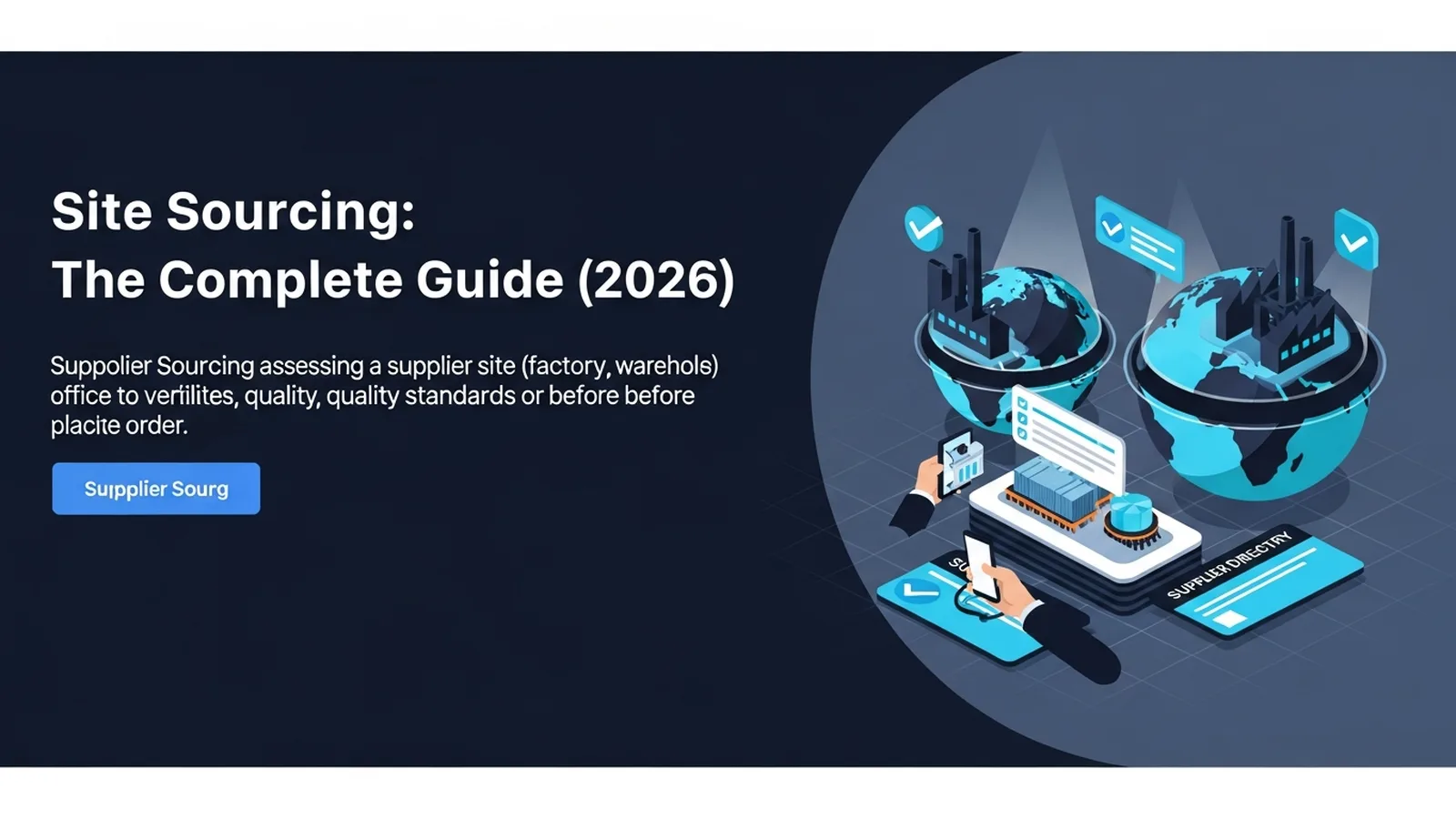
Site Sourcing: The Complete Guide (2026)
This site sourcing guide explains assessing a supplier's factory, warehouse, or office to verify capabilities and legitimacy before ordering.
Hylke Reitsma is co-founder of Forthsuite and a supply chain specialist with 8+ years of hands-on experience at Shell, Verisure, and Stryker. He holds an MSc in Supply Chain Management from the University of Groningen and writes practical guides to help e-commerce teams run leaner, faster supply chains. Selected by Replit as 1 of 20 founders for the inaugural Race to Revenue Cohort #1 (2026) and certified as a Replit Platform Builder.
Last updated: July 2026
What is site sourcing?
Site sourcing is the practice of assessing a supplier's physical location as part of your purchasing decision. Unlike catalogue-based sourcing — where you evaluate products based on photos and spec sheets alone — site sourcing gives you direct evidence that the supplier has the production capacity, quality systems, and business legitimacy they claim.
The term is used across manufacturing, wholesale, and e-commerce supply chains. For Shopify and DTC brands importing from overseas factories, site sourcing is the most reliable way to avoid supplier fraud, capacity misrepresentation, and quality failures before they reach your customers.
Site sourcing vs product sourcing — what's the difference?
Product sourcing is the end-to-end process of identifying, evaluating, and contracting with a supplier for a specific product. It covers everything from initial market research and supplier discovery through to sample review, price negotiation, and first purchase order.
Site sourcing is a specific due diligence step within that process. It focuses exclusively on the supplier's physical site — whether you are evaluating it in person, via a third-party audit, or using remote verification tools. You can complete product sourcing without site sourcing (many brands do, often at their peril), but site sourcing is what separates verified supplier relationships from assumptions.
A useful analogy: product sourcing is like researching a house to buy; site sourcing is the building inspection. You can skip the inspection, but the risk is yours.
The site sourcing process: step by step
- Identify candidate suppliers. Use trade data platforms, Alibaba, 1688, trade shows, or sourcing platforms to build a shortlist. At this stage you are evaluating product fit, minimum order quantities, and price range — not yet site credibility.
- Desktop verification. Before any site visit or sample order, verify the supplier's business registration against official Chinese government registries (SAMR / GSXT), customs export records, and import databases. This step filters out brokers posing as factories, ghost listings, and recently formed entities with no export history. Forthsource automates this step and returns a supplier risk score in minutes.
- Request documentation. Ask for: business licence, ISO or product-specific certification (CE, RoHS, BSCI, etc.), recent third-party audit report, and a reference list of current buyers. A legitimate factory will provide these without hesitation.
-
Site assessment — remote or in-person.
- Remote: Request a live video tour of the production floor, storage areas, and quality inspection station. Use a third-party inspection company (QIMA, SGS, Bureau Veritas) if you need an independent report.
- In-person: Conduct your own factory audit or attend a sourcing trip. Key areas to inspect: production machinery condition, workforce size vs claimed capacity, raw material traceability, and QC rejection logs.
- Sample and quality validation. Order pre-production samples and benchmark them against your spec sheet before committing to a bulk order. Site sourcing tells you the factory can produce; samples confirm they will produce to your standard.
- Ongoing monitoring. Site sourcing is not a one-time event. Annual re-audits catch changes in ownership, capacity, and quality systems that can creep in after the initial relationship is established.
Remote site sourcing: how to verify suppliers without a factory visit
Most Shopify and DTC brands cannot justify the cost and time of an in-person factory visit, especially for first-time orders with a new supplier. Remote site sourcing combines several verification layers:
- Supplier verification platforms — Forthsource cross-references the supplier's stated identity against Chinese business registration records, customs import/export databases, and trade data. It flags mismatches between claimed capacity and actual export volume, and surfaces historical buyer complaints. See how we verify suppliers.
- Third-party audit companies — QIMA, SGS, Bureau Veritas, and Asia Inspection conduct physical factory audits on your behalf, typically for $200-$500 per audit. They provide a detailed report covering capacity, compliance, and quality systems.
- Trade data analysis — US Customs and Panjiva data shows actual export history. A factory claiming 500,000 units of monthly capacity with zero recorded exports in the last 24 months is a red flag. Global sourcing platforms often include access to this data.
- Video factory tours — Request a live video call (not a pre-recorded tour) during production hours. Ask to see the production line for your specific product category, quality inspection station, and raw material storage. Reluctance to do this is itself a signal.
- Reference checks — Ask for 2-3 current buyers in a similar category. A 10-minute call with a reference buyer will reveal more about a supplier's reliability than any document they can provide.
Site sourcing red flags
These are the most common signals that a supplier has not been adequately site-sourced — or that the site sourcing results were not favourable:
- No verifiable business registration or registration less than 12 months old
- Refuses to share third-party audit reports
- Factory address on Google Maps shows a residential building or empty lot
- Export history does not match claimed capacity or product category
- Multiple product categories that are inconsistent with a single production facility
- Communication always routes through a trading company, never the factory directly
- Extremely low MOQs for complex products (often indicates brokering, not manufacturing)
- Sample quality significantly better than production quality
How Forthsource supports site sourcing
Forthsource automates the desktop verification phase of site sourcing for e-commerce brands importing from China, Vietnam, and Southeast Asia. It generates a supplier trust score by cross-referencing:
- Chinese business registration (SAMR/GSXT) — active status, registered capital, ownership changes
- Customs import/export records — actual export volume vs claimed capacity
- Trade data — product category consistency, buyer history
- AI-powered verification signals — sentiment from buyer mentions, dispute history, certification validity
For brands that have previously used product sourcing services or supplier sourcing tools, Forthsource plugs directly into the verification step — giving you a structured risk score in minutes rather than the days or weeks a manual desktop audit takes.
Start verifying suppliers free →
Frequently asked questions
What is site sourcing?
Site sourcing is the practice of evaluating a supplier's physical location — factory, warehouse, or production facility — to verify their manufacturing capabilities, quality controls, and business legitimacy before placing an order. It is a key step in global supplier due diligence, particularly when sourcing from overseas manufacturers in China, Vietnam, India, or other regions.
What is the difference between site sourcing and product sourcing?
Product sourcing is the broader process of finding and selecting suppliers for a specific product. Site sourcing is a sub-step within that process that focuses specifically on evaluating the supplier's physical facility. You can source a product without doing site sourcing (e.g., using trade data alone), but site sourcing gives you a much higher confidence that the supplier has the actual capacity and quality systems claimed in their listings.
How do I do site sourcing without visiting the factory myself?
Remote site sourcing uses a combination of: (1) third-party inspection companies (SGS, Bureau Veritas, QIMA) who conduct physical audits on your behalf; (2) supplier verification platforms like Forthsource that cross-reference business registration data, customs import records, and trade databases; (3) video factory tours requested directly from the supplier; and (4) reference checks with other buyers who have worked with the same facility.
What do you look for during site sourcing?
During site sourcing you assess: production capacity (can they handle your order volume?), quality management systems (ISO certifications, in-line inspection processes), equipment condition and age, workforce size and skills, raw material storage and traceability, compliance with labour and environmental standards, and whether the facility matches what was shown in photos and product listings. Red flags include a showroom-only visit (no production floor access), refusal to share business registration, and third-party audit reports that cannot be verified.
Is site sourcing only for large brands?
No. Site sourcing is valuable at any order size, but the approach scales with your budget. Small brands (under 500 units) can use desktop verification tools and request video tours. Mid-size brands (500-5,000 units) benefit from a paid third-party audit report (typically $200-$500). Larger brands typically conduct on-site audits for every new supplier and annual audits for ongoing partners.
How does Forthsource help with site sourcing?
Forthsource automates the desktop portion of site sourcing by cross-referencing a supplier's claimed identity against Chinese business registration records, customs import/export databases, and historical trade data. It generates a supplier trust score, flags discrepancies between claimed capacity and actual export volume, and surfaces buyer reviews from brands who have worked with the same factory. You can verify a supplier in minutes instead of weeks.
Further reading
About the Author

Hylke Reitsma is co-founder of Forthsuite and a supply chain specialist with 8+ years of hands-on experience at Shell, Verisure, and Stryker. He holds an MSc in Supply Chain Management from the University of Groningen and writes practical guides to help e-commerce teams run leaner, faster supply chains. Selected by Replit as 1 of 20 founders for the inaugural Race to Revenue Cohort #1 (2026) and certified as a Replit Platform Builder.
LinkedIn