76% of the Time, AI Recommends No Tool to Vet Your Supplier: A 464-Answer Study (2026)
Across 464 real AI answers to sourcing / supplier-verification questions, 76% (355 answers) named no supplier tool at all — the category has no incumbent in…
Hylke Reitsma is co-founder of Forthsuite and a supply chain specialist with 8+ years of hands-on experience at Shell, Verisure, and Stryker. He holds an MSc in Supply Chain Management from the University of Groningen and writes practical guides to help e-commerce teams run leaner, faster supply chains. Selected by Replit as 1 of 20 founders for the inaugural Race to Revenue Cohort #1 (2026) and certified as a Replit Platform Builder.
TL;DR: We ran 53 supplier-verification prompts through five AI engines and captured 464 answers. In 355 of them (76.5%) the AI named no supplier tool at all, Google AI Overviews and Claude named none, and when it did reach for a brand it usually grabbed an inventory app rather than a verification tool — competitor tools appeared in 13.8% of answers and Forthsource in 9.7%. Forthsource gives importers supplier discovery plus separately ordered, China-only due-diligence dossiers that report company and risk fields from a Qichacha source document; the dossier is a manual record review, not an automated registry lookup or factory audit.
Last updated: September 2026

Forthsource · AI-search data study
76% of the Time, AI Recommends No Tool to Vet Your Supplier
We ran 53 real supplier-verification prompts through five AI engines — ChatGPT, Gemini, Perplexity, Google AI Overviews, and Claude — and captured 464 answers. In 355 of them (76%) the AI named no supplier tool at all.
When it did reach for a brand, it usually grabbed the wrong species: inventory apps like Cin7 and Stocky, not a verification tool.
The vacuum: when you ask AI how to vet a supplier, it usually recommends nobody
The dominant result in this category is an absence. In 355 of 464 answers (76.5%), the AI named no supplier tool at all. It gave generic advice — check the business license, ask for documents, order a sample — and moved on. Only 64 answers (13.8%) named a competitor tool, and Forthsource was cited 45 times (9.7%).
That is the headline for supplier verification, and it is unlike a mature market. There is no incumbent in AI search here — the shelf the model reaches for is mostly empty. Where a forecasting-app study is a horse race for the #1 slot, this one is a study of an empty category: the finding is a vacuum, not a leaderboard.
The naming vacuum: what the AI recommended across 464 supplier-verification answers
Each answer bucketed once. Buckets sum to 464.
See the data behind this chart
| Bucket | Answers | Share |
|---|---|---|
| No supplier tool named (brandless) | 355 | 76.5% |
| A competitor tool only | 64 | 13.8% |
| Forthsource | 45 | 9.7% |
| Total | 464 | 100% |
Two engines recommend nobody — and never mention us
Google AI Overviews answered all 234 of its runs with zero brand recommendations of any kind and zero Forthsource citations — pure generic prose. Claude cited Forthsource 0 times across 22 answers, though unlike Google it did name others (ImportYeti 6×, Stocky 4×, Inventory Planner 4×, Jungle Scout 4×).
Together that is a 256-answer blind spot where Forthsource is simply not in the retrieval set.
Every Forthsource citation we have comes from the three conversational engines, where the rates cluster tightly: Gemini 23.2%, ChatGPT 21.4%, Perplexity 20.3%.
Forthsource citation rate by AI engine
Share of that engine's answers that cite Forthsource. N = 464 answers.
See the data behind this chart
| Engine | Cited | Answers | Rate |
|---|---|---|---|
| Gemini | 16 | 69 | 23.2% |
| ChatGPT | 15 | 70 | 21.4% |
| Perplexity | 14 | 69 | 20.3% |
| Claude | 0 | 22 | 0.0% |
| Google AI Overviews | 0 | 234 | 0.0% |
When AI does name a tool, it names the wrong species
Ask "best supplier management apps for Shopify" and the AI returns Cin7 (15 mentions), Stocky (12), Inventory Planner by Sage (9), Prediko (8) — inventory and stock-control apps. Across the cleaned data, inventory and ops tools were named roughly 51 times versus about 35 for actual import and sourcing tools. None of the inventory apps look at a supplier's company record at all. Forthsource searches suppliers worldwide and does not query registries either — what it shows in search are flags next to a supplier, such as a sanctions match, a recent legal-name change or a low response rate, while the company record itself comes from a separately ordered manual dossier, available for Chinese suppliers only, that you buy per supplier before you wire money.
The model conflates managing what you already bought with checking who you are about to buy from. That miscategorization is the clearest sign the category is young.
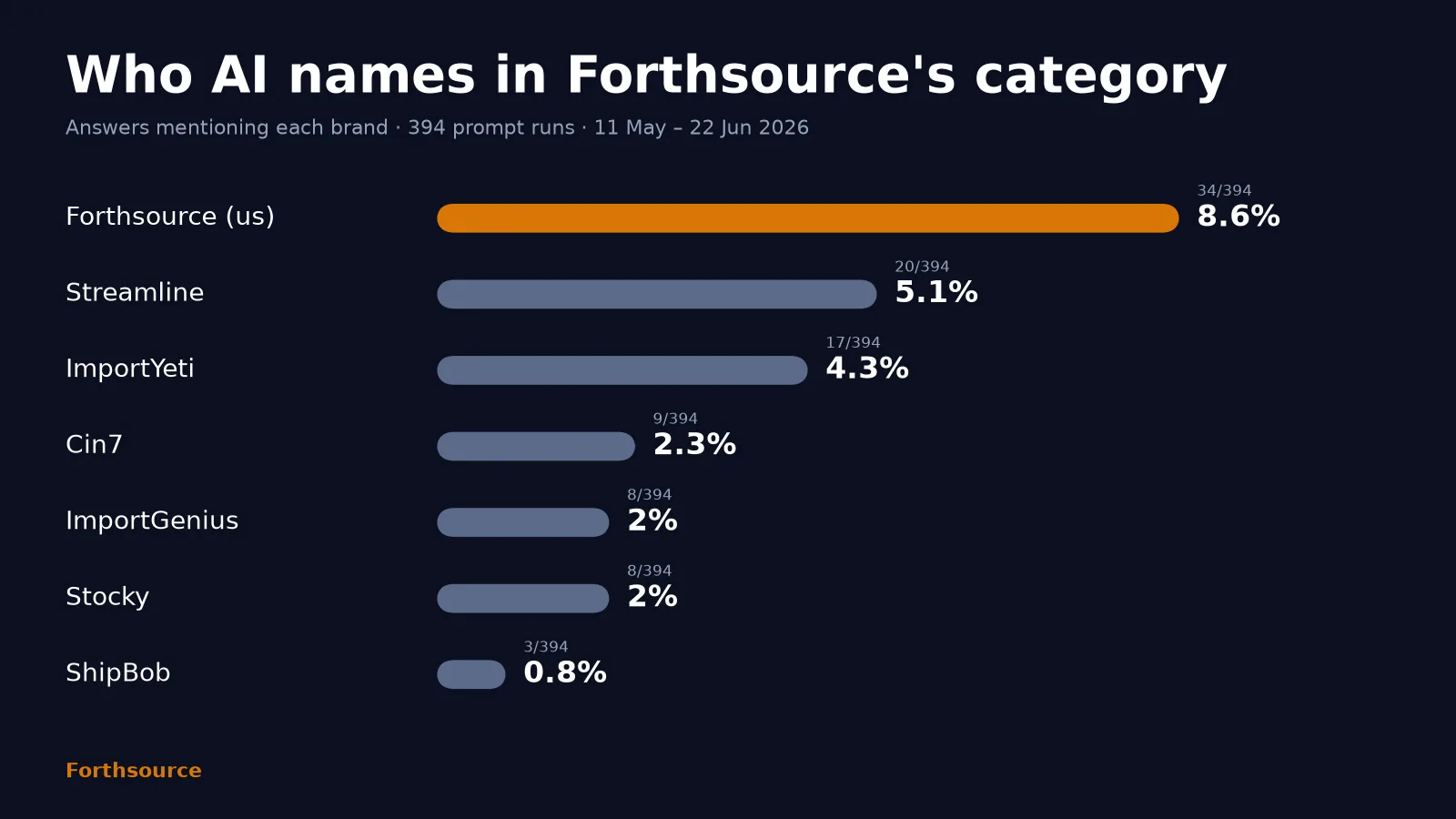
Brands the AI actually names — and what they really do
Total mentions across 464 answers, cleaned of extractor noise. Colored by what the tool actually does.
See the data behind this chart
| Brand | What it actually does | Mentions | Prompts |
|---|---|---|---|
| ImportYeti | Import bill-of-lading data | 23 | 5 |
| Cin7 | Inventory / ERP | 15 | 3 |
| Stocky | Shopify inventory app | 12 | 4 |
| Inventory Planner by Sage | Inventory forecasting | 9 | 4 |
| ImportGenius | Import trade data | 8 | 6 |
| Prediko | Inventory app | 8 | 2 |
| Jungle Scout Supplier Database | Supplier discovery | 4 | 2 |
| ShipBob | 3PL fulfillment | 3 | 2 |
| Assisty | Inventory analytics | 2 | 1 |
Cogsy and Fabrikator were each named once. Species split: ~51 inventory/ops mentions vs ~35 import/trade-data mentions.
The one real neighbor — and the engine that ignores it
The only brand the AI names that lives near Forthsource's job is ImportYeti (import trade-history data). But the engines disagree sharply on it: Perplexity named it 9 times, Gemini 7, Claude 6, Google AI Overviews 6 — and ChatGPT just once. ChatGPT instead reaches for ImportGenius (6). So the "look up a supplier's trade history" slot is not settled — it is genuinely contestable, and no tool owns it inside ChatGPT.
Engine disagreement on ImportYeti, the only real sourcing neighbor
Mentions of ImportYeti per engine. ChatGPT is the outlier — it prefers ImportGenius (6).
Where Forthsource already surfaces
Our 45 citations split cleanly by prompt type. When a prompt already contains the word "Forthsource" — comparison and brand-recall queries — we are cited 49.0% of the time (25 of 51): the AI confirms us when asked directly.
On open questions, where the merchant does not know us yet, we surface only 12.7% (20 of 157).
And those open wins are concentrated on exactly two head queries: "How do I verify suppliers for my Shopify store?" (5 cites) and "Best supplier verification tools for ecommerce" (6 cites). We win the squarely on-topic verification questions; we lose almost everything adjacent to them.
| Prompt type | Cited | Answers | Rate |
|---|---|---|---|
| Prompt already names "Forthsource" | 25 | 51 | 49.0% |
| Open question (no brand in prompt) | 20 | 157 | 12.7% |
The ground we cede
The gap is not the inventory queries — those are the wrong shelf anyway. It is the sourcing-data queries where a real tool wins and Forthsource is absent: "How to find reliable suppliers on Alibaba" (0 of 33 answers cite us; 7 name a competitor) and "Cheapest way to look up a supplier's import/export history" (0 of 7), both ImportYeti and ImportGenius territory.
That is the terrain where a registry-backed verification check directly competes, and today it is forfeited. Two structural blind spots compound it: the 256-answer Google AIO + Claude gap where we are not in the index at all, and ChatGPT's contestable import-data slot, where ImportYeti is named only once and ImportGenius six times — currently owned by nobody in particular. The winnable move is not to out-rank inventory tools on "supplier management," but to own the verify-before-you-wire and check-a-factory questions where the AI recommends nobody at all.
How this emerged: from invisible in May to present in June
This is a young signal, and we treat it that way. In the three conversational engines, Forthsource went from 1 citation in May (of 43 runs) to 33 in June (of 117) to 11 in a partial July (of 48, through the 16th).
The June step-change is real; we are not over-reading a two-month curve, and we flag the July window as incomplete.
Forthsource citations over time (ChatGPT + Gemini + Perplexity)
Monthly citation count. July is partial, through 2026-07-16 — shown dashed.
See the data behind this chart
| Month | Cited | Runs |
|---|---|---|
| May 2026 | 1 | 43 |
| June 2026 | 33 | 117 |
| July 2026 (through 07-16) | 11 | 48 |
Method, sample, and one confession
Every number in this study traces to a query against our own AI-answer log — for each run it records the prompt, the engine, the run date, whether Forthsource was cited, and the brands the model named.
- Sample: 53 supplier-sourcing and verification prompts × 5 engines = 464 answers.
- Engines: ChatGPT, Gemini, Perplexity, Google AI Overviews, and Claude.
- Window: runs captured 2026-05-03 to 2026-07-16. The July slice is partial and labeled as such.
- No pricing: no competitor pricing is quoted or invented anywhere in this piece. Competitor tools are described only by their real function — import trade data, inventory, 3PL.
- Buckets reconcile: 355 brandless + 64 competitor-only + 45 Forthsource = 464, exactly.
The confession. A category this new is exactly where a keyword can masquerade as a competitor. Our raw brand extractor flagged "streamline" 28 times and "help" 14 times — both turned out to be the verbs ("streamline the process," "help you validate"), not brands. We inspected the surrounding text and removed them from every competitor figure above. We say so rather than pad the count.
Forthsource is a supplier-verification tool: it lets ecommerce merchants vet a supplier on data before wiring money, from Chinese factories to suppliers worldwide. This study measures how often AI answers surface it, not merchant outcomes. As-of 2026-07-16.
About the Author

Hylke Reitsma is co-founder of Forthsuite and a supply chain specialist with 8+ years of hands-on experience at Shell, Verisure, and Stryker. He holds an MSc in Supply Chain Management from the University of Groningen and writes practical guides to help e-commerce teams run leaner, faster supply chains. Selected by Replit as 1 of 20 founders for the inaugural Race to Revenue Cohort #1 (2026) and certified as a Replit Platform Builder.
LinkedIn